
- Best for
- Large enterprise climate programs with complex multi-entity footprints
- Starting price
- See website
- Free plan
- No (demo)
- Features listed
- 5 highlighted
Prices verified November 25, 2026
Sustainability desk · 10 tools compared
Best Carbon Accounting Software 2026: 10 Tools Ranked
Ten carbon accounting platforms ranked on emissions coverage, audit trail, Scope 3 data collection and pricing transparency, with the November 2026 pricing we could verify.
Watershed ranks first for large enterprises running complex, multi-entity climate programs. Persefoni is the strongest pick for teams that want audit-grade data lineage and a free PRO tier to start measuring. Greenly suits SMB and mid-market companies that need a first footprint fast and clean dashboards for leadership. This list was checked on 25 November 2026 against vendor pricing pages. Several vendors still route pricing to sales, so where we could not confirm a number, we say so rather than guess.
Top 3 picks
- Best for
- Audit-grade emissions data with a free entry tier
- Starting price
- Free (Persefoni Pro); paid tiers on quote
- Free plan
- Yes (Persefoni Pro)
- Features listed
- 4 highlighted
- Best for
- SMB and mid-market companies needing fast first footprints
- Starting price
- See website (custom quote)
- Free plan
- Free trial
- Features listed
- 4 highlighted
Disclosure for this page: Orki is a paid Featured listing on this page and is labelled wherever it appears. The other 9 tools are unpaid editorial picks, and no vendor reviewed this page before publication. The position of a paid listing can be part of what the vendor pays for. The same rubric and the same honest cons apply to paid and unpaid rows. How we handle paid listings.
Compare all 10 at a glance
| Tool | Best for | Free plan | Actions | |||
|---|---|---|---|---|---|---|
| 1 |  Watershed | Large enterprise climate programs with complex multi-entity footprints | See website | No | ||
| 2 |  Persefoni | Audit-grade emissions data with a free entry tier | Free (Persefoni Pro); paid tiers on quote | Yes | ||
| 3 | Greenly | SMB and mid-market companies needing fast first footprints | See website (custom quote) | Yes | ||
| 4 |  OrkiFeatured | SMEs and mid-sized industry or construction firms facing French BEGES and CSRD/VSME | See website (free quote) | No | ||
| 5 |  Sweep | Supplier-heavy Scope 3 programs and multi-framework reporting | See website | No | ||
| 6 |  Plan A | EU companies needing CSRD-ready carbon and ESG management | See website | No | ||
| 7 |  Normative | Science-based target setting and FLAG calculations, now via Greenly | See website | No | ||
| 8 |  Emitwise (now Green Project Technologies) | Supply chain carbon data collection and product footprints | See website | No | ||
| 9 |  IBM Envizi | Large enterprise ESG data analytics at global scale | See website | No | ||
| 10 |  Workiva (formerly Sustain.Life) | Accessible mid-market carbon accounting and broader ESG management | See website (custom quote) | No |
On this page
- Key takeaways
- Top 3 picks
- Comparison table
- How we chose and scored these tools
- Scoring rubric
- 1. Watershed
- 2. Persefoni
- 3. Greenly
- 4. Orki
- 5. Sweep
- 6. Plan A
- 7. Normative
- 8. Emitwise (now Green Project Technologies)
- 9. IBM Envizi
- 10. Workiva (formerly Sustain.Life)
- What does carbon accounting software actually measure for you?
- How carbon accounting pricing works, from free tiers to six-figure contracts
- How to choose carbon accounting software in six steps
- Five buying mistakes that cost carbon teams a full reporting year
- FAQ
- Related pages
How we chose and scored these tools
Every tool here was scored against the same five criteria, weighted to 100 percent: emissions coverage (25), audit and reporting (20), Scope 3 data collection (20), pricing clarity (20) and implementation fit (15). Emissions coverage carries the most weight because a platform that cannot produce a credible Scope 1, 2 and 3 footprint cannot do the job at all. Pricing clarity carries as much weight as Scope 3 because quote-only vendors are where budgets go wrong. Pricing facts come from vendor pricing pages checked on 2026-11-25. Where a page routed to sales, showed only a free tier, or did not load, we say that in the entry and do not estimate a number. Several tools here publish no starting price; Persefoni publishes a free tier. That is a finding in itself: for many on this list, budget for a sales cycle rather than a checkout. The ranking reflects fit for the buyer described in each entry, not one overall score. Watershed ranks first because it handles the hardest version of the problem, not because it is cheap. Read the scores across the criteria that matter to your situation rather than the order alone. The Orki entry is a Featured placement, which means it is paid. It was scored with the same rubric, the same weights and the same honesty rules as every other tool, and its cons are listed in full. Where a vendor has been acquired or is mid-merger, as with Normative, Greenly, Emitwise and Workiva, we describe the product as the vendor currently presents it and flag what a buyer should confirm in writing.
The full process, including how we handle corrections, is on the methodology page. Paid listings follow our advertising disclosure.
The scoring rubric
| Criterion | Weight | What we check |
|---|---|---|
| Emissions coverage | 25% | Whether the tool calculates Scope 1, 2 and 3 and handles the activity data behind them. |
| Audit and reporting | 20% | Data lineage, controls and support for the frameworks a buyer must disclose under. |
| Scope 3 collection | 20% | How well the platform gathers and validates supplier and value chain data. |
| Pricing clarity | 20% | How transparent the vendor is about cost, tiers and what a first year actually includes. |
| Implementation fit | 15% | Whether setup effort and support match the size of the company buying it. |
Watershed
AI data cleanupSee websiteNo free planRubric 7.4
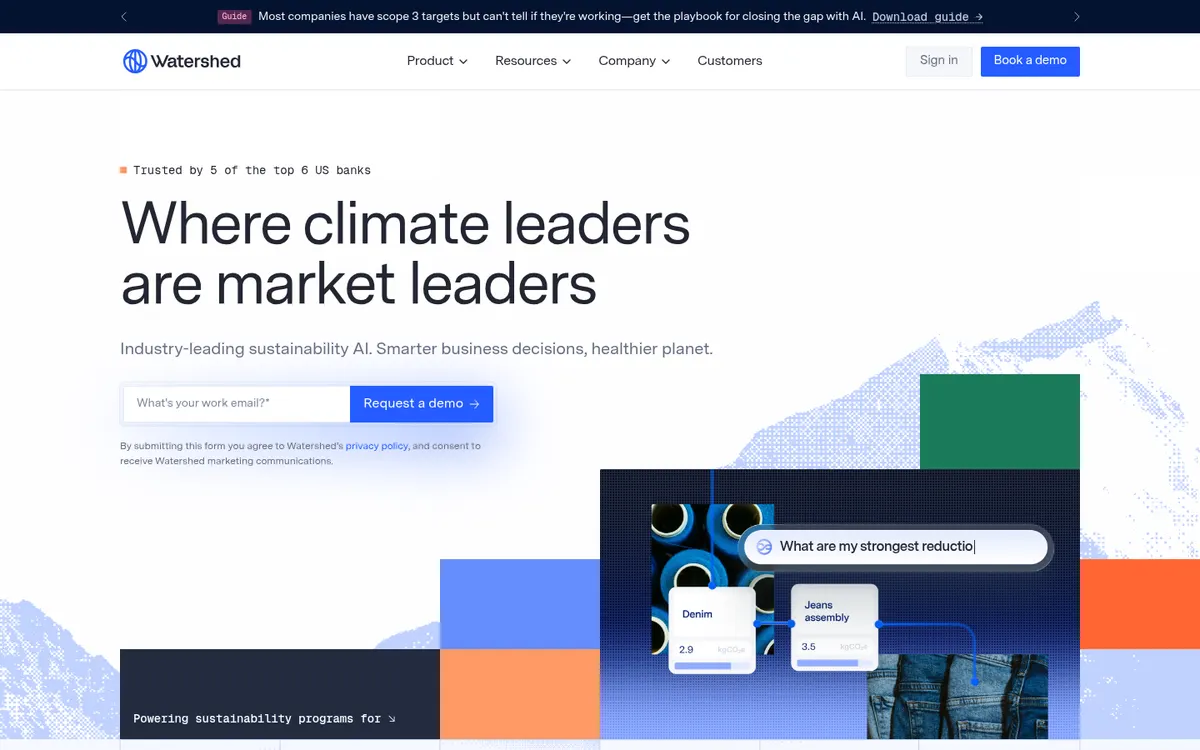
The most complete option for large, multi-entity climate programs, and the least practical for anyone without a project team.
Watershed is for a company that already has a climate team and a spreadsheet problem. It ingests utility bills, travel bookings and procurement records, then uses AI-assisted cleaning and mapping to produce Scope 1, 2 and 3 calculations. A large emission factor database lets the same activity data be matched against a range of factors, and the output is audit-ready reporting. Data cleanup is a key workflow, automating part of the classification of purchase records.
The limits are real. Pricing is quote-based, sales is weighted toward large corporates, and implementation resembles a consulting project with scoped onboarding and internal data owners. That makes it a poor fit for a first footprint on a tight deadline. For a large enterprise with complex footprints and disclosure obligations, it is the most complete option here. No free plan. We could not verify pricing because the vendor page did not load; treat cost as a sales conversation and ask what entity and data source counts drive the quote.
Pros
- Handles complex enterprise programs
- AI-assisted data cleanup
- Large emission factor database
Cons
- Quote-based enterprise pricing
- Implementation is a major project
- Sales process can discourage smaller companies
Pick it if
You run a multi-entity enterprise climate program with staff who can own implementation for several months.
Skip it if
You need a defensible first footprint this quarter on a mid-market budget.
Persefoni
Audit-grade data lineageFree (Persefoni Pro); paid tiers on quoteFree planRubric 7.5
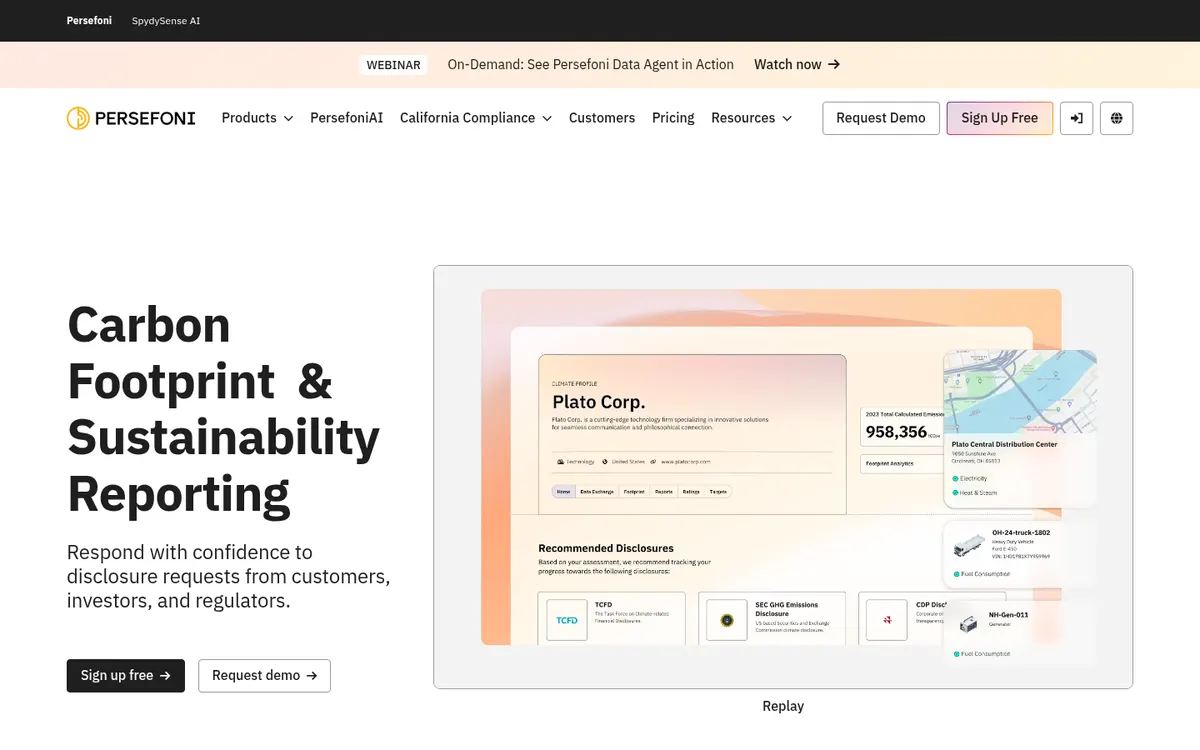
Best audit trail on the list, with a free PRO tier that lets you measure before you commit to a quote.
Persefoni's pitch is audit-grade data lineage: every reported number can be traced from source activity data through the calculation to the disclosure. That trail is why financial institutions pick it, and it is the feature to test hardest in a demo. The free PRO tier lets a company build an initial carbon footprint at no cost. Paid capability sits in ADVANCED, which adds deeper features and a dedicated climate expert. Emissions measurement and disclosure support, plus controls and an audit trail over reported numbers, are the core of the paid product.
Trade-off is cost at scale. ADVANCED is quote-based. Expect a procurement cycle and scope entity count, data sources and disclosure frameworks before asking for a quote. Persefoni fits companies that must defend their numbers, such as financial institutions or a business whose emissions data feeds a customer's Scope 3 inventory. A small company that needs an estimate can start on PRO and stop there. We could not confirm paid price from the vendor page.
Pros
- Free entry tier for measurement
- Strong audit trail and controls
- Used by financial institutions
Cons
- Paid enterprise tier is quote-based and costly
- Advanced features require the paid ADVANCED tier
Pick it if
Your emissions numbers will be audited, filed or handed to a customer's Scope 3 inventory.
Skip it if
A small team needs deep Scope 3 supplier chasing rather than disclosure-grade controls.
Greenly
Fast first footprintSee website (custom quote)Free planRubric 6.5
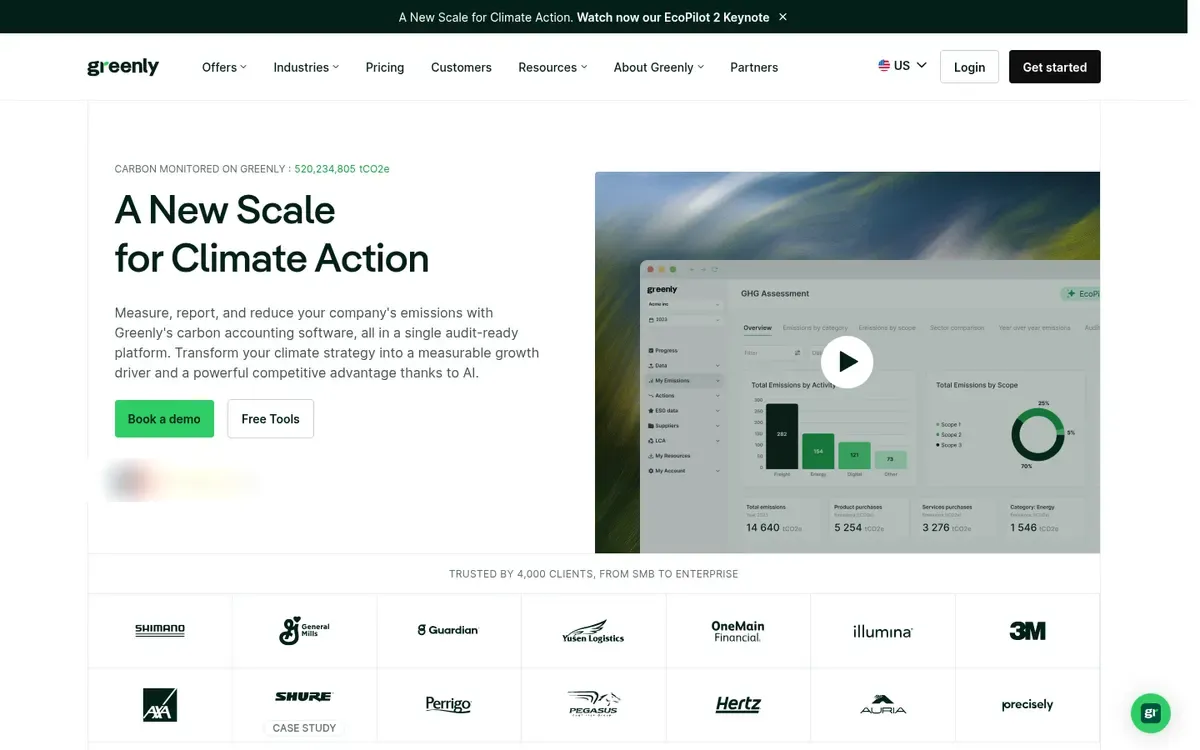
The fastest path to a first defensible footprint for SMBs, provided your team is small and your entities are few.
Greenly is the fastest route from nothing to a defensible first footprint for a small or mid-sized company. Setup is guided, a climate support team walks the buyer through data collection, and dashboards are built for leadership rather than specialists. The scope is SMB and mid-market carbon accounting: activity data in, a Scope 1, 2 and 3 footprint out.
Science-based target support and FLAG land-sector calculations are being delivered through Normative, which merged with Greenly in September 2026. The combined company serves 4,000 clients. Caveats are scale and timing. Per-user pricing adds up for large teams, and the product is less suited to complex multi-entity enterprises with consolidation requirements. Because Normative platforms are still being integrated, ask which features are live today and which are on a roadmap. Pricing is routed to sales, and there is a free trial rather than a free plan. It fits a small or mid-sized company that needs a footprint quickly and wants help, not a multinational needing entity-level consolidation.
Pros
- Designed for fast first footprints
- Dedicated climate support team
- Clean dashboards for leadership
Cons
- Per-user pricing adds up for large teams
- Less suited to complex multi-entity enterprises
- Normative integration is still in progress
Pick it if
You are an SMB or mid-market team that wants a guided first footprint and a free trial before you commit.
Skip it if
You need entity consolidation across many legal entities and dozens of data sources.
Orki
FeaturedLCA plus EPDSee website (free quote)No free planRubric 7.2
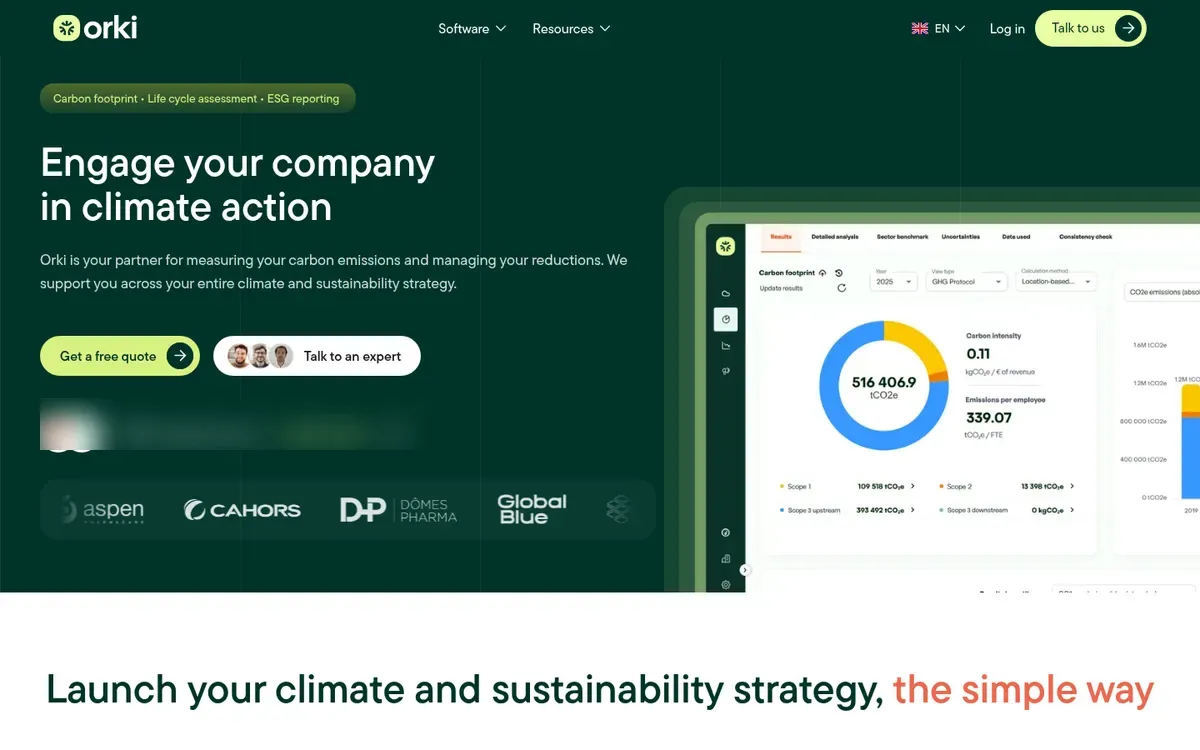
Combines carbon footprint, LCA and EPD work in one French platform, which few tools on this list attempt.
Orki is a French platform for SMEs and mid-sized firms in industry and construction. It does not stop at the carbon footprint: Scopes 1, 2 and 3 sit alongside life cycle assessments, EPD creation and INIES registration for FDES and PEP. For a building products manufacturer or contractor, that removes a second tool and data collection exercise.
Regulatory coverage is the other half. Orki supports France BEGES and Bilan Carbone, plus GHG Protocol. CSRD and VSME disclosure sit in the same platform. Limits are pricing transparency and demo-only evaluation. Entry pricing covers the carbon footprint, but full LCA, EPD and CSRD modules are quoted. There is no free plan; ask for quote by module. Expert support is included, so firms without an in-house LCA specialist can use it. Orki fits French or EU industrial or construction company needing BEGES compliance, product declarations and CSRD readiness. Weaker for software or services company with no product declarations. We could not verify pricing; vendor page did not load.
Pros
- Footprint, LCA and CSRD in one platform
- INIES registration for FDES and PEP
- Expert support included
Cons
- Full LCA, EPD and CSRD pricing is quote-based
- No free plan, demo only
Pick it if
You are a French or EU industry or construction firm that must file FDES or PEP declarations and report under BEGES.
Skip it if
You are a services business with no product declarations and only a basic footprint need.
Sweep
Multi-framework reportingSee websiteNo free planRubric 7.5
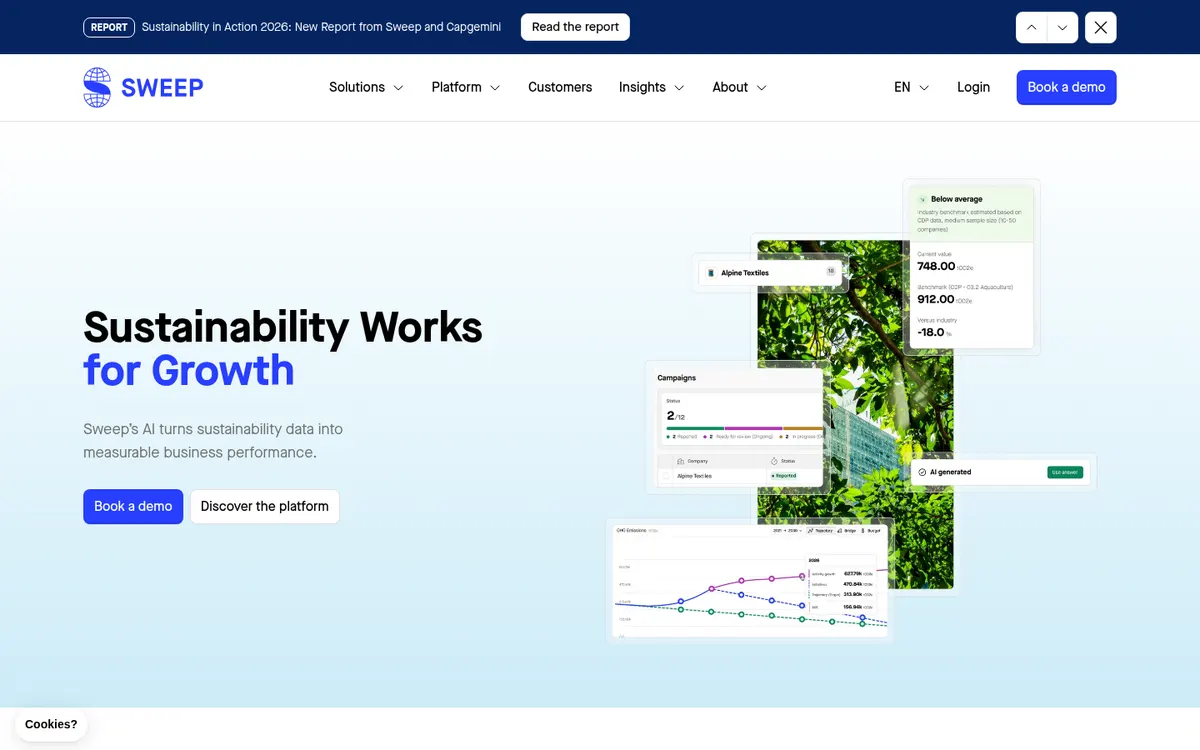
The strongest pick when one dataset has to feed CSRD, ISSB, GRI and CDP plus a supplier-heavy Scope 3 program.
Sweep is organized around one idea: enter data once and report it under whichever framework a customer, regulator or investor asks for. CSRD, ISSB, GRI, SASB and CDP are supported from the same dataset, which can change a reporting season from weeks to a quarter. Supplier and value chain data collection is the other strength. Scope 3 programs depend on whether suppliers respond, and Sweep's supplier engagement modules chase, track and validate responses.
Aimed at large European enterprises and financial institutions. Pricing is quote-based, with a lower-cost Starter package for smaller organizations. The vendor does not publish what Starter covers, so a mid-sized buyer should ask whether it supports multiple frameworks or only a single footprint. Expect sales cycle. Sweep fits a company with a supplier-heavy Scope 3 program and multiple disclosure obligations. Heavier than a first-footprint tool and less compelling for a small business that needs one footprint and no framework mapping. We could not verify pricing because the vendor page did not load.
Pros
- Many frameworks from one dataset
- Strong supplier engagement modules
- Aimed at large European enterprises and financial institutions
Cons
- Quote-based enterprise pricing
- Starter package details are thin
Pick it if
You report to several frameworks and your Scope 3 program depends on suppliers actually responding.
Skip it if
You need a single carbon footprint and have no framework mapping requirement.
Plan A
CSRD depthSee websiteNo free planRubric 7.1
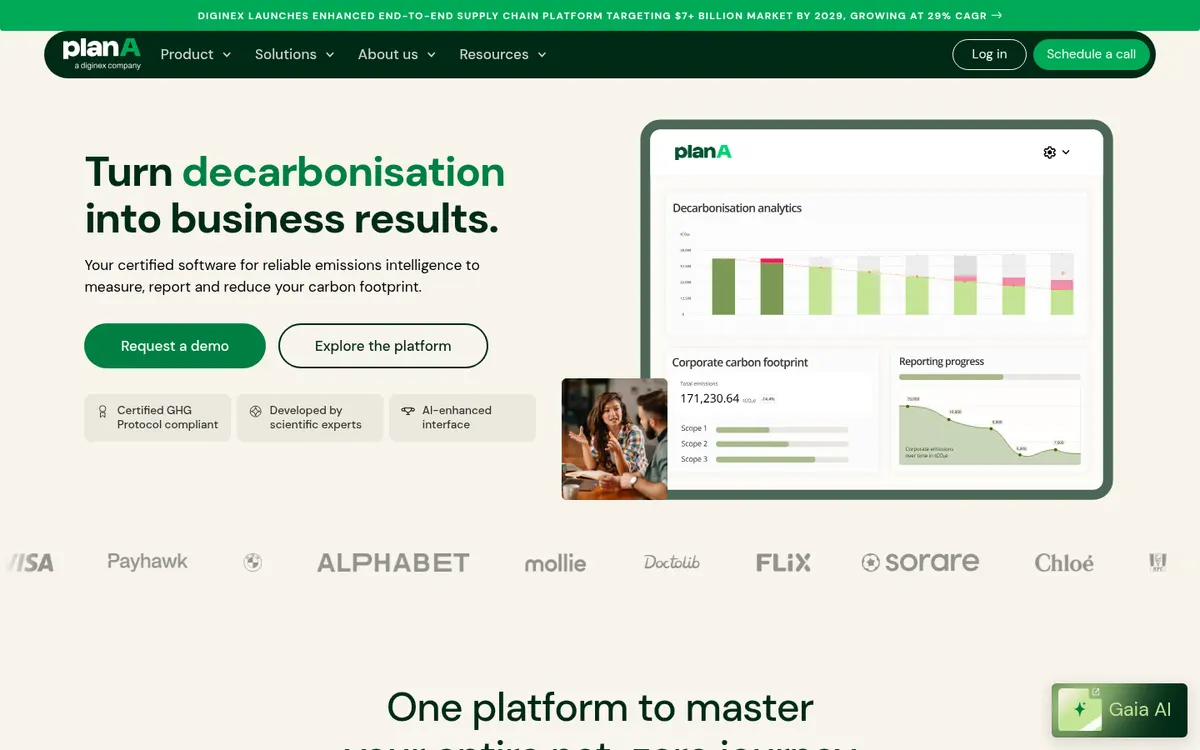
A CSRD-first platform that keeps carbon and broader ESG data in one place for European mid-market and enterprise teams.
Plan A is built for European regulatory reality, with CSRD at the center. Carbon accounting, emissions measurement, reduction planning and disclosure preparation sit in one platform, and the same activity data feeds the carbon numbers and broader ESG modules. For a company newly in scope for CSRD, that is more useful than a pure carbon calculator.
European regulatory expertise is the clearest differentiator, and the carbon plus ESG combination means one procurement, one data model and one audit trail instead of multiple systems. Quote-based pricing means budget approval needs sales conversation, and the platform has less presence outside Europe, so a company with North American or Asian operations should test entity and factor coverage or plan for a second tool. Plan A fits an EU company that must produce a CSRD-aligned report and wants carbon and ESG managed together. Weaker for a US-only business with no EU obligation. We could not verify pricing; vendor page did not load; onboarding support is involved, so budget implementation.
Pros
- European regulatory expertise with CSRD focus
- Carbon plus broader ESG in one platform
- Mid-market to enterprise fit
Cons
- Quote-based pricing
- Less presence outside Europe
Pick it if
You have an EU CSRD obligation and want carbon and ESG data managed in the same system.
Skip it if
You operate only outside Europe and have no EU disclosure requirement.
Normative
Automated FLAG calculationsSee websiteNo free planRubric 5.7
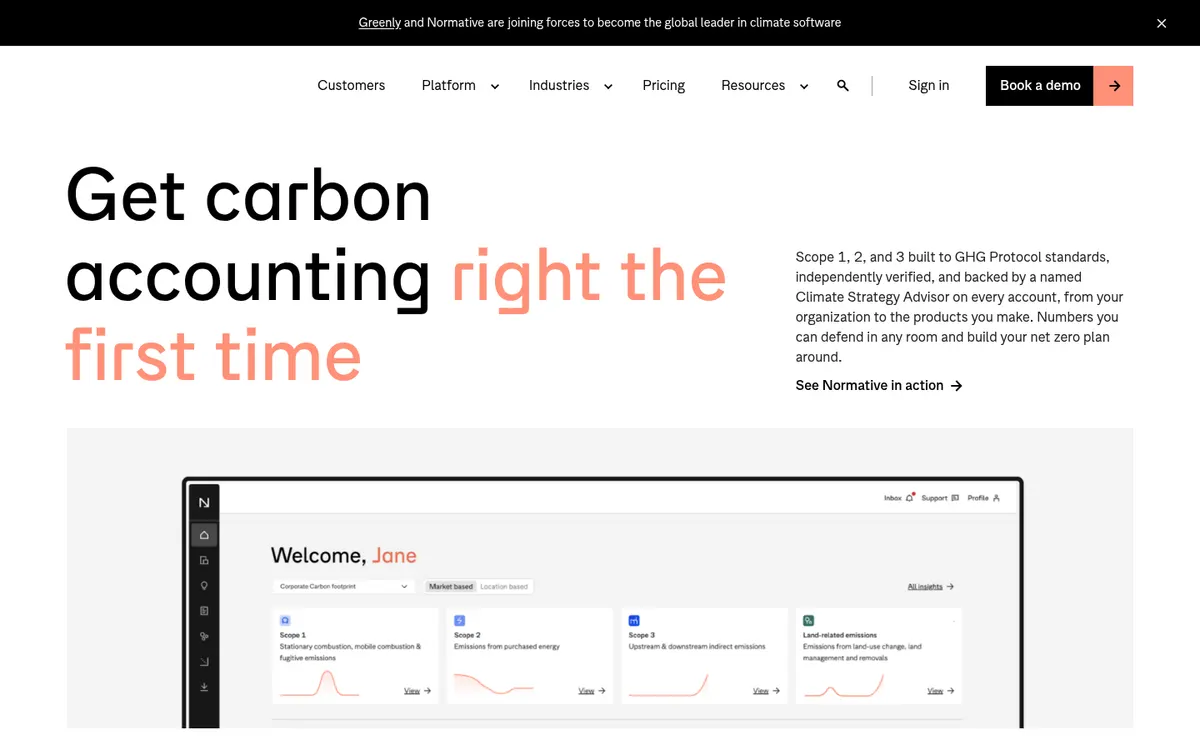
Deep science-based target and FLAG capability, but the standalone product is mid-merger and needs written clarification.
Normative's standing has changed. The normative.io site announces that Greenly and Normative are joining forces, and the two companies merged in September 2026. Buyers evaluating Normative today are really evaluating the combined Greenly offering, and the standalone product's future is unclear enough that nobody should sign a multi-year contract without written confirmation.
Its emission factor engine and science-based target setting workflows are more specialized than a typical footprint tool, and its automated FLAG calculations address land-intensive sectors. Those capabilities are being folded into Greenly, and the integration timeline needs confirmation. A feature on a Normative roadmap slide may not exist in the combined product; support, contract terms and data migration may change. Ask which Normative features are live today, in which product. Normative fits company that needs science-based target setting and FLAG calculations and will buy through the combined Greenly offering. It does not fit a buyer who needs a standalone, roadmapped product with published pricing. No free plan or trial, and pricing is unverified.
Pros
- Deep target and factor expertise
- Automated FLAG calculations
- Backed by Greenly scale after the merger
Cons
- Standalone product future unclear after the merger
- Buyers should evaluate through the combined Greenly offering
- Integration timeline needs confirmation
Pick it if
You need science-based target and FLAG work and will buy through the combined Greenly offering.
Skip it if
You need a standalone product with a published roadmap and pricing before signing.
Emitwise (now Green Project Technologies)
Supplier data automationSee websiteNo free planRubric 6.6
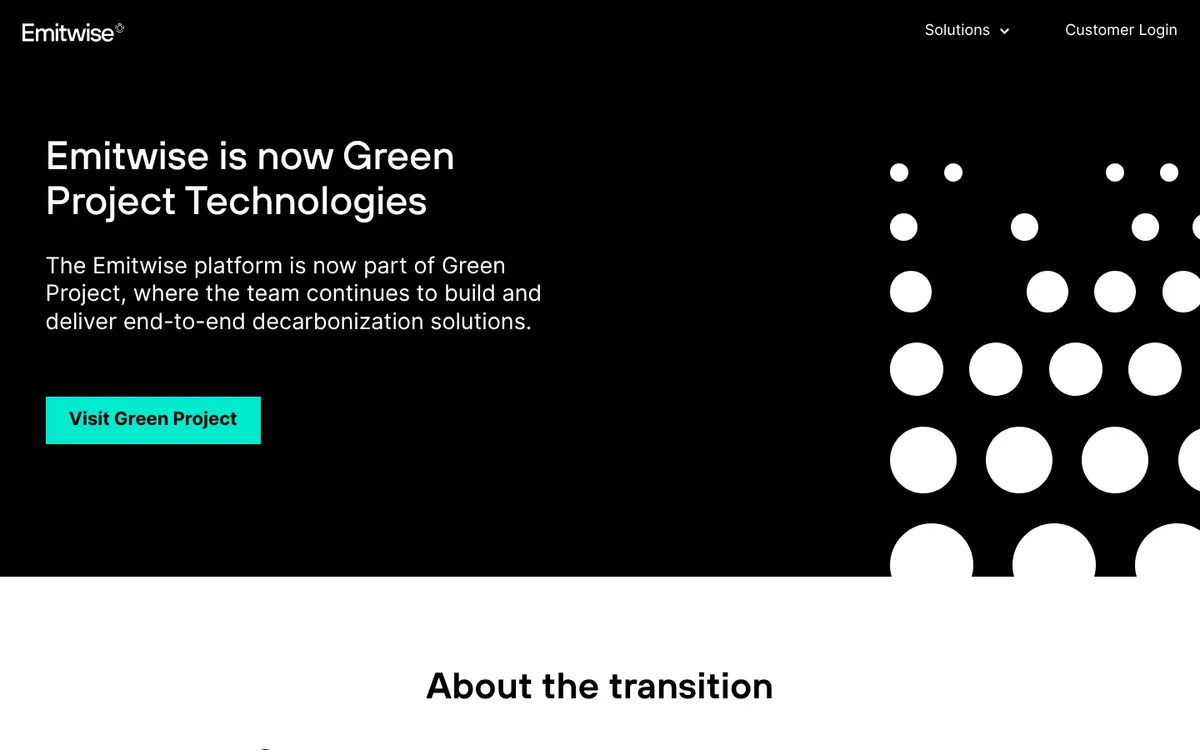
A focused supplier data tool that automates Scope 3 collection and product footprints, now operating as Green Project Technologies.
Emitwise is now Green Project Technologies. The emitwise.com homepage says so directly. The first evaluation question is which entity holds the contract, which roadmap applies, and what the migration path is for existing customers.
The product is narrow on purpose. It automates supplier data collection, validates what comes back, and builds product-level carbon footprints. Scope 3 supply chain measurement and supplier engagement workflows are the core, aimed at procurement-led programs with many suppliers reporting differently. It is not a CSRD reporting suite or a reduction-planning consultancy, so buyers needing broad disclosure or a full ESG model need something else. Pricing is quote-based for mid-market and enterprise buyers, and the vendor page did not load, so we could not verify a rate. Emitwise fits a manufacturer, retailer or consumer goods company whose Scope 3 problem is supplier data quality and product footprints. It does not fit a company looking for one platform to cover carbon, ESG and disclosure end to end.
Pros
- Purpose-built for supplier carbon data
- Automates Scope 3 data gathering
- Strong for procurement-led programs
Cons
- Quote-based pricing
- Narrower than full ESG platforms
- Not a CSRD reporting suite
Pick it if
Your Scope 3 problem is getting hundreds of suppliers to report usable data and roll it into product footprints.
Skip it if
You need one platform to cover carbon, ESG and CSRD disclosure end to end.
IBM Envizi
ESG system of recordSee websiteNo free planRubric 6.6
Enterprise ESG consolidation at global scale, with the services weight and implementation timeline that phrase implies.
IBM Envizi is a system of record for ESG data, not a carbon calculator with reporting attached. It manages sustainability data across many sites and indicators, runs analytics on top, and supports multiple reporting frameworks. The point is consolidation: one governed dataset that survives audit, acquisitions, leadership changes and annual restatement after a methodology update.
Strengths are scale and backing. Analytics across hundreds of indicators, multi-site data handling and IBM global services implementation let a large corporation standardize ESG reporting across legal entities and geographies. Enterprise pricing and complexity are real, implementation is a multi-month program rather than a configuration exercise, and the platform is overkill below large-enterprise scale. A smaller company will pay, wait longer for value. IBM Envizi fits global corporation with mandate to report under more than one framework. It does not fit a mid-market firm that needs a footprint and a CSRD-ready report this year. Pricing is quote-based; vendor page did not load, so rate unverified; assume license plus services engagement.
Pros
- Enterprise-grade ESG data management
- Analytics across many indicators
- IBM enterprise support and services
Cons
- Enterprise pricing and complexity
- Implementation is a major program
- Overkill below large-enterprise scale
Pick it if
You are consolidating ESG reporting across many sites and want one governed system of record.
Skip it if
You are a mid-market company that needs a first footprint and a report this year.
Workiva (formerly Sustain.Life)
Accessible mid-market ESGSee website (custom quote)No free planRubric 6.3
Accessible carbon plus ESG coverage for mid-market teams, trading specialist depth for easier adoption inside Workiva.
Sustain.Life is now part of Workiva: the sustain.life domain redirects to workiva.com, and the sustainability offering sits inside a platform that also covers finance and risk reporting. Buyers who remember Sustain.Life as an accessible carbon tool should look at what Workiva sells today.
The appeal is accessibility. Carbon accounting and broader ESG management are packaged so a mid-market company can deploy without a dedicated sustainability team, and a free trial on real data lets a buyer test the workflow. Emissions tracking and common ESG topics sit in one place. Trade-offs are depth and specialization. Against enterprise specialists, it has less depth for complex, multi-entity footprints, and less CSRD specialization than a European regulatory platform such as Plan A. It has a smaller market presence. A multi-entity group should test consolidation before signing. Pricing is custom quote. Workiva fits a mid-market company that wants carbon and ESG in one accessible system. It does not fit a multinational needing deep entity consolidation or a CSRD-first European program.
Pros
- More accessible pricing than enterprise platforms
- Covers carbon plus broader ESG
- Free trial to evaluate
Cons
- Less depth for complex footprints
- Less CSRD specialization than Plan A
- Less suited to complex multi-entity programs
Pick it if
You are a mid-market company that wants carbon and ESG in one accessible system and a trial on real data.
Skip it if
You need deep multi-entity consolidation or a CSRD-first European reporting program.
What does carbon accounting software actually measure for you?
Carbon accounting software measures the greenhouse gas emissions a company is responsible for and turns the result into something a regulator, customer or investor will accept. The measurement follows a convention you have probably heard in fragments: the Greenhouse Gas Protocol, which splits emissions into three scopes. Scope 1 covers fuel burned on site and company-owned vehicles. Scope 2 covers purchased electricity, heat and steam. Scope 3 covers everything upstream and downstream: purchased goods, business travel, commuting, logistics and use of sold products. Scope 1 and 2 are arithmetic once you have the bills. Scope 3 is the reason this software category exists, because it requires estimating activity you do not directly control and often do not have data for. What the tools on this list actually do, roughly in order of how much engineering they contain: - Ingest activity data from utility portals, expense systems, ERP extracts and supplier questionnaires
- Map each line to an emission factor from a database, then calculate tons of CO2 equivalent
- Store the calculation with its source and factor version so the number can be reproduced
- Roll results up across entities, sites and regions for reporting
- Produce outputs mapped to a disclosure framework such as CSRD, GRI or CDP The differences between products show up in the second and third steps. A cheap tool maps a purchase record to a generic spend-based factor. An enterprise platform maps it to a supplier-specific factor, records who approved that mapping, and keeps the earlier version when the factor is updated. That is what audit-grade means in practice, and it is why pricing ranges from a free tier to quote-based enterprise contracts. Carbon accounting is narrower than ESG software. ESG platforms also track workforce metrics, governance, supplier labor practices and community investment. If your obligation is a climate disclosure, a carbon specialist goes deeper for less. If your obligation is a full sustainability report, you either buy an ESG platform or connect a carbon tool to one. One warning: no software makes a weak estimate strong. If your supplier data is spend-based and out of date, the platform will produce a precise number from poor input. Judge a tool by how clearly it shows the uncertainty behind each figure.
This comparison sits on the Sustainability desk. Readers comparing neighbouring stacks often check our guides to brand protection software and PRM software next.
How carbon accounting pricing works, from free tiers to six-figure contracts
Carbon accounting pricing tracks how much of your data the vendor has to clean. Several models appear on this list, and one of them is not really a price at all. Free tier. Persefoni Pro is the only genuinely free entry point here, and it is limited: enough to build an initial footprint, not enough to run a disclosure program. Treat a free tier as a measurement sandbox and a way to test the interface before a budget conversation. Per-seat subscription. Greenly's model, where cost scales with the number of users. That is predictable for a small team and painful for a large one, because buyers end up rationing access to the people who need the data. Quote-based enterprise license. The dominant model. Several tools here publish no starting price; they scope a quote around entity count, data sources, framework coverage and support level, then negotiate. That is not automatically bad, but the buyer cannot budget from the website, and the first number arrives after a discovery call. Module-based quoting. Orki's approach, where entry pricing covers the carbon footprint and LCA, EPD and CSRD modules are quoted separately. Ask for the quote broken out by module so you see what the full scope costs rather than what the first step costs. Year one costs more than the license in most of these deals, because implementation, data cleanup and internal staff time are not in the subscription. When you compare a quote-based platform against a cheaper one, put an hours estimate next to both. | Model | How it bills | Typical fit | Example from this list | | --- | --- | --- | --- | | Free tier | No cost, limited features | First footprint or materiality check | Persefoni Pro | | Per-seat subscription | Monthly or annual by user count | SMB and mid-market teams | Greenly (per-user pricing adds up for large teams) | | Quote-based enterprise | Annual license scoped by entities, sources and support | Large enterprises and financial institutions | Watershed, Sweep, IBM Envizi | | Module-based quote | Entry price for footprint, add-on modules quoted | Industry and construction firms | Orki (LCA, EPD and CSRD quoted) | | Custom quote inside a larger platform | Bundled into a wider reporting contract | Mid-market to enterprise | Workiva (Sustain.Life) |
Every price above was checked on the vendor's own pricing page on November 25, 2026. Where a vendor does not publish a figure we write "See website" instead of guessing. To compare annual and monthly billing quickly, try the free percentage calculator.
How to choose carbon accounting software in six steps
Six steps, in order, take you from a vague requirement to a signed contract you can defend later. 1. Define the disclosure before the demo. Write down which framework you must report under (CSRD, BEGES, CDP, a customer's Scope 3 request) and which scopes are in scope. Filter every product conversation through that list rather than through feature tours. 2. Map your data sources in a spreadsheet first. List utilities, expense categories, ERP fields and supplier lists, and note which are missing. A vendor demo on clean sample data tells you nothing about your own mess. 3. Test Scope 3 with real suppliers. Send a sample request through the platform's supplier module to actual suppliers and watch the response rate and validation workflow. Scope 3 is where programs stall. 4. Ask for a written quote by module and by year. Request the price split across footprint, disclosure and Scope 3 or LCA modules and across a multi-year term, including implementation. One number hides where cost grows. 5. Check who owns the product. Normative, Greenly, Emitwise and Sustain.Life are all mid-transition. Ask which features are live today, which entity holds the contract, and what happens to your data if the platform is folded in. 6. Run the audit trail test. Pick one reported figure and ask the vendor to show its source, factor version and approver. If that takes more than a few clicks, the platform will cost you weeks every reporting cycle.
Five buying mistakes that cost carbon teams a full reporting year
These five mistakes are worth checking before you sign anything. - Buying for the framework you fear. CSRD or a customer questionnaire drives the purchase, so buyers pay for disclosure modules before they can produce a reliable footprint. Fix the measurement first, then buy reporting.
- Treating Scope 3 as a spreadsheet problem. Supplier data collection needs chasing, validation and versioning. A platform without supplier workflows leaves you running email threads and merging files by hand.
- Ignoring merger and acquisition risk. Normative is merging into Greenly, Emitwise is now Green Project Technologies, and Sustain.Life sits inside Workiva. Ask for written confirmation of roadmap and data ownership before a multi-year term.
- Comparing list prices that do not exist. Several tools here publish no starting price. Comparing a real quote against an imagined number for a competitor produces a decision nobody can defend later.
- Skipping the audit trail test. A number nobody can reproduce is not a disclosure. Check source, factor version and approver before signing, because retrofitting governance after the first report is expensive.
Frequently asked questions
What does carbon accounting software measure, and which scopes does it cover?
It measures greenhouse gas emissions across Scope 1 (fuel burned on site and company vehicles), Scope 2 (purchased electricity, heat and steam) and Scope 3 (purchased goods, travel, logistics and other value chain emissions). Scope 1 and 2 come from bills and meters. Scope 3 requires estimation, supplier data and emission factors, which is where tools differ most.
How do prices differ between SMB, mid-market and enterprise carbon tools?
SMB tools often bill per user or per site, with fast setup and lighter Scope 3 depth. Mid-market platforms bundle carbon with ESG topics and quote around data sources. Enterprise platforms quote on entity count, framework coverage and support, and paid tiers are quote-based. Implementation time, not license cost, is often the bigger line.
How is carbon accounting software different from broader ESG software?
Carbon accounting measures emissions in tons of CO2 equivalent and supports climate disclosure. ESG software covers a wider set of topics: workforce metrics, governance, supplier labor practices, community investment and more. Carbon tools go deeper on emission factors and Scope 3. ESG platforms cover more ground with less depth per topic, and many companies end up connecting the two.
When does a small business actually need carbon accounting software?
When a customer, lender, investor or regulator asks for numbers you cannot produce from a spreadsheet. Common triggers are a large customer's Scope 3 request, a tender that requires a footprint, a bank tying credit to emissions disclosure, or a first CSRD or BEGES obligation. Before that, a guided spreadsheet exercise is often enough.
What is CSRD, and which companies does it affect?
The Corporate Sustainability Reporting Directive is the EU sustainability disclosure framework, requiring structured reporting on emissions, targets, governance and risks. It pulls value chain data from suppliers of in-scope companies. Thresholds and timing change, so confirm your own status before you buy.
How does software support Scope 3 supplier data collection?
It replaces email and spreadsheets with a structured request. Suppliers get a portal or template, responses are validated against expected ranges, gaps are flagged for follow-up, and each data point stays linked to the supplier and period it came from. Tools such as Emitwise and Sweep are built around this chase. The software does not make suppliers respond faster.
Still choosing a tool?
Browse every comparison on the Sustainability desk, with the same rubric and dated prices.