
- Best for
- Large enterprises running global partner programs
- Starting price
- See website
- Free plan
- No (demo available)
- Features listed
- 5 highlighted
Prices verified November 25, 2026
Sales desk · 10 tools compared
Best PRM Software 2026: 10 Tools Ranked for Channel Teams
Ten partner relationship management platforms ranked by lifecycle coverage, pricing clarity, CRM fit, speed to launch and portal usability, with prices checked on November 25, 2026.
Impartner is the best PRM software for large enterprises running global partner programs, Salesforce PRM is the right pick when Salesforce is already your system of record, and Introw suits B2B SaaS teams running partner programs inside HubSpot or Salesforce. That order held after we rechecked vendor pricing pages on November 25, 2026. The ten tools below split into enterprise suites with quote-only contracts, mid-market platforms with modular editions, and leaner options with published prices, including Kiflo at $399 per month and ZINFI at $1,450 per month.
Top 3 picks
- Best for
- Companies already using Salesforce as their system of record
- Starting price
- See website
- Free plan
- No (demo only)
- Features listed
- 4 highlighted
- Best for
- B2B SaaS teams running partner programs inside HubSpot or Salesforce
- Starting price
- Free (Starter, 1 partner); paid plans on quote
- Free plan
- Yes (Starter plan, 1 partner)
- Features listed
- 5 highlighted
Disclosure for this page: Introw is a paid Featured listing on this page and is labelled wherever it appears. The other 9 tools are unpaid editorial picks, and no vendor reviewed this page before publication. The position of a paid listing can be part of what the vendor pays for. The same rubric and the same honest cons apply to paid and unpaid rows. How we handle paid listings.
Compare all 10 at a glance
| Tool | Best for | Free plan | Actions | |||
|---|---|---|---|---|---|---|
| 1 | Impartner | Large enterprises running global partner programs | See website | No | ||
| 2 | Salesforce PRM | Companies already using Salesforce as their system of record | See website | No | ||
| 3 |  IntrowFeatured | B2B SaaS teams running partner programs inside HubSpot or Salesforce | Free (Starter, 1 partner); paid plans on quote | Yes | ||
| 4 |  Channelscaler | Mid-market and enterprise teams wanting a modern, usable portal | See website | No | ||
| 5 |  Channeltivity | Companies seeking predictable PRM pricing and modular editions | See website (custom quote) | No | ||
| 6 |  PartnerStack | B2B SaaS companies running affiliate, referral and co-sell programs | See website (custom quote) | No | ||
| 7 |  Unifyr | Channel teams prioritizing through-partner marketing | See website (custom quote) | No | ||
| 8 |  Kiflo | SMBs and SaaS teams launching their first partner program | Core $399/month (annual contract, up to 50 partners) | No | ||
| 9 |  Magentrix | Teams wanting a deeply customized portal on their own CRM data | Essentials from $1,500/month (annual contract) | No | ||
| 10 |  ZINFI | Enterprises wanting one platform across the full partner lifecycle | Starter $1,450/month ($17,400/year) | No |
On this page
- Key takeaways
- Top 3 picks
- Comparison table
- How we chose and scored these tools
- Scoring rubric
- 1. Impartner
- 2. Salesforce PRM
- 3. Introw
- 4. Channelscaler
- 5. Channeltivity
- 6. PartnerStack
- 7. Unifyr
- 8. Kiflo
- 9. Magentrix
- 10. ZINFI
- What does partner relationship management software actually do for a channel program?
- How PRM software pricing works in 2026
- Which PRM software fits your program? A six step decision path
- PRM buying mistakes that stall a rollout
- FAQ
- Related pages
How we chose and scored these tools
We scored each of the ten platforms on five criteria and weighted them for the way channel teams actually buy. Lifecycle coverage carries 25 percent, because a platform that stops at deal registration usually needs a second tool within a year. CRM fit carries another 25 percent: how cleanly the platform works with Salesforce, HubSpot or Dynamics without a fragile sync layer. Portal usability carries 20 percent, since partners abandon portals that need a training session. Pricing clarity and speed to launch take 15 percent each. Prices and plan facts come from vendor pricing pages checked on November 25, 2026. Where a vendor publishes nothing, we say so and mark the entry quote only rather than repeating third-party figures as fact. Where a page lists a rate, we use that rate. Where a vendor does not publish pricing, we mark the entry quote only. The featured listing in this guide is a paid placement. It is scored with the same rubric and carries the same kind of cons as every other tool on the page. Scores appear per criterion rather than as one blended number, so you can re-weight them for your own program. Where tools are close, we break the tie on lifecycle depth and support for programs with more than one partner type. A tool can also score well on one line and still rank low overall: ZINFI scores high on coverage and publishes a starter price, but implementation scope and day-to-day usability are why it sits at the bottom of this order rather than the top.
The full process, including how we handle corrections, is on the methodology page. Paid listings follow our advertising disclosure.
The scoring rubric
| Criterion | Weight | What we check |
|---|---|---|
| Lifecycle coverage | 25% | How much of recruitment, onboarding, enablement, deal registration, incentives and reporting one platform handles. |
| Pricing clarity | 15% | Whether the vendor publishes rates, tiers and contract terms a buyer can plan a budget against. |
| CRM fit | 25% | How cleanly the platform works with Salesforce, HubSpot or Dynamics without a fragile sync layer. |
| Speed to launch | 15% | How quickly a channel team can get a working portal and deal registration in front of partners. |
| Portal usability | 20% | How much of the partner experience runs on self-serve screens that partners can use without training. |
Impartner
Lifecycle breadthSee websiteNo free planRubric 7.6
The broadest lifecycle platform here, built for global channel networks that can staff a dedicated operations role.
Impartner is the widest partner lifecycle platform here, priced accordingly. Modules cover recruitment and onboarding, SCORM training and certification, deal registration, incentives and MDF, compliance checks, and a partner marketplace with a no-code locator. Automated journeys move a reseller from application to first deal without handoffs. The strength is scale: large global programs need compliance, tiered incentives and a directory. CRM sync puts partner pipeline beside direct pipeline, making the channel number forecastable.
None of this is instant. Every module has settings, and automation helps only after someone decides what the journey should look like. Pricing is quote only; rates are not published. Setup is among the heaviest here, with a project plan, data migration and an owner per module. Teams treating implementation as a side task end up with a portal partners ignore. It fits large global networks where enablement and incentives are real budget lines. Smaller programs may pay for capacity they never switch on. Start with deal registration and onboarding, then add training and MDF once partners use the portal weekly.
Pros
- Full lifecycle from recruitment to MDF
- Deep CRM sync for channel pipeline
- No-code partner locator for end-customer search
Cons
- Quote only pricing
- Heavy implementation needs dedicated staff
- Automation depends on configuration work
Pick it if
You run a large global program and can staff a channel operations role.
Skip it if
You have a small partner program and nobody with time to configure and maintain the platform.
Salesforce PRM
Native CRM dataSee websiteNo free planRubric 7.4
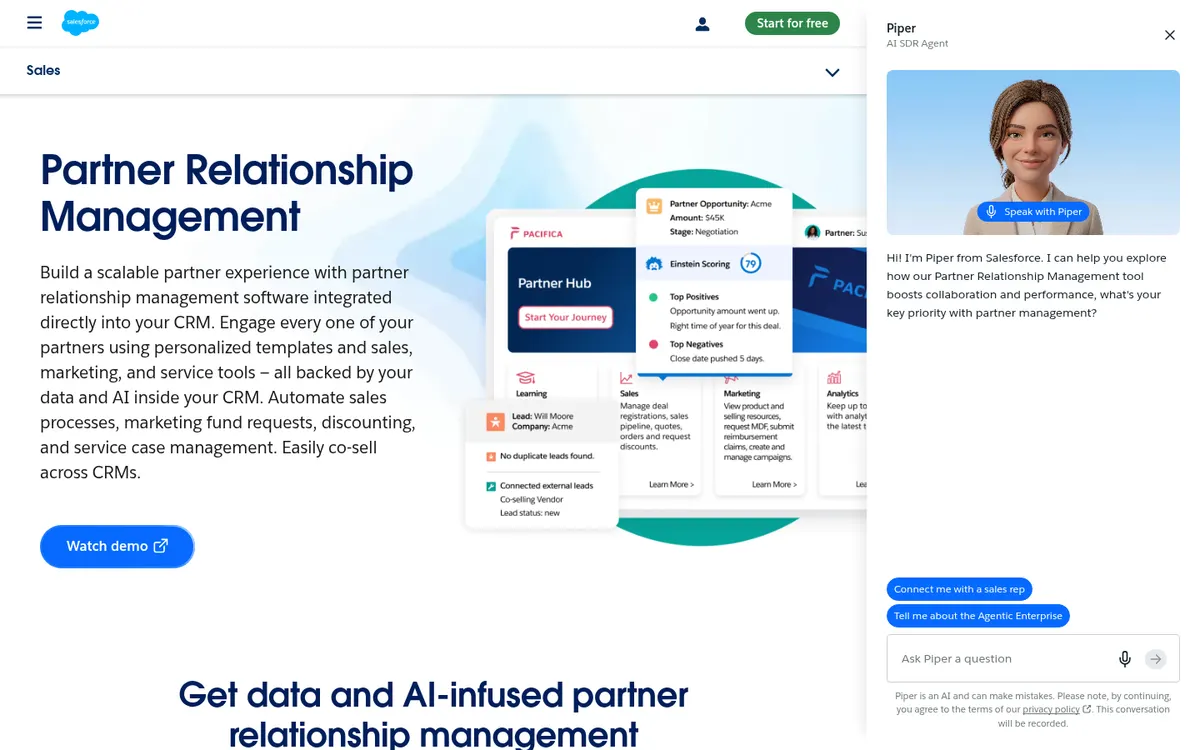
The right answer only for Salesforce shops with admin capacity, where native data beats a faster launch.
Salesforce PRM is a build on Experience Cloud, formerly Partner Community. Deal registration, lead distribution and pipeline management run on standard Salesforce objects, and the partner portal is a Salesforce site. Partner data sits natively in the CRM, so there is no sync layer to monitor, reconcile or rebuild. If your sales team already works in Salesforce, partner-sourced deals appear in the same reports and forecasts without middleware.
The customization ceiling is as high as your admin team can reach, and security and compliance inherit from the platform. The cost is real: licensing is billed annually, and implementation often requires consulting. Partner experience depends on the portal build. A rushed Experience Cloud site feels like a support portal. You need admin capacity after launch, because every new program rule becomes a configuration request with a queue. It fits existing Salesforce customers with internal Salesforce skills. Companies without Salesforce, or without an admin to spare, may find a purpose-built platform better. Budget for the build, not just the license, and test the partner login flow on a phone.
Pros
- No separate sync layer to maintain
- Inherits Salesforce security controls
- Very high customization ceiling
Cons
- High total cost with licensing plus consulting
- Portal quality depends on your admin team
- Slow to launch compared with lean tools
Pick it if
Salesforce already runs your sales motion and you have admins who can build a partner portal.
Skip it if
You are not on Salesforce or would need to hire consulting help for every change.
Introw
FeaturedNative CRM operationFree (Starter, 1 partner); paid plans on quoteFree planRubric 7.2
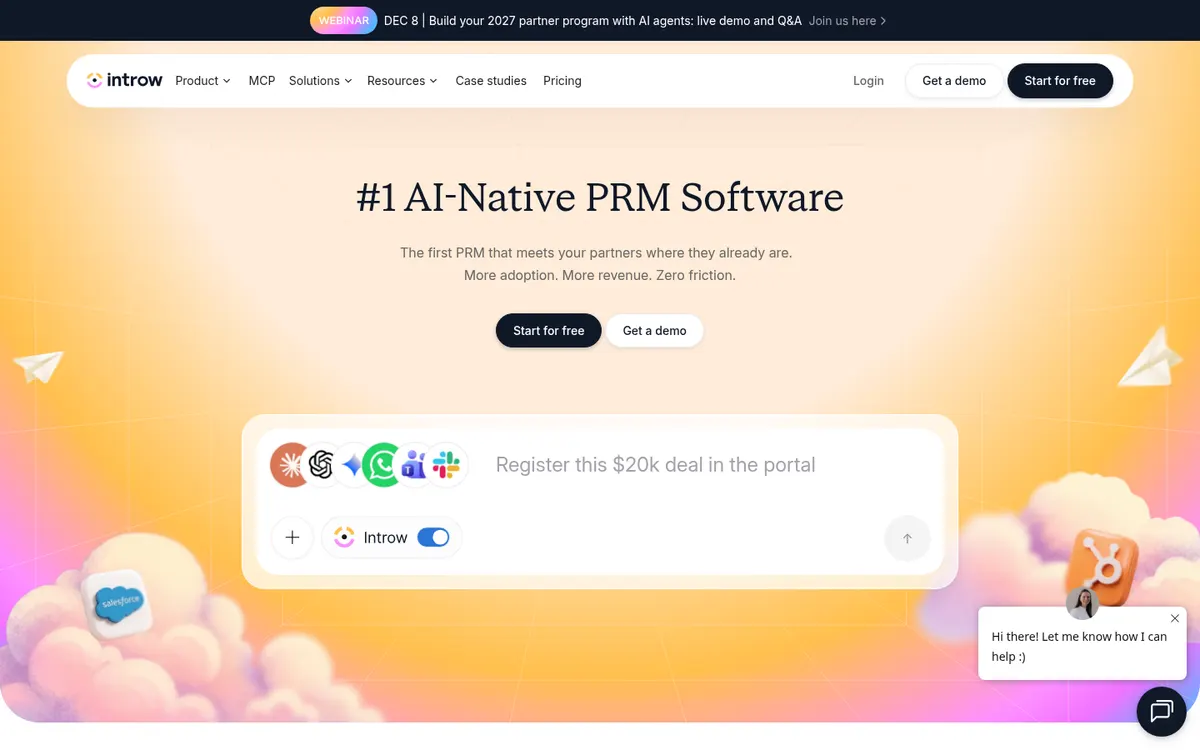
A lean, native option that suits SaaS teams already running pipeline inside HubSpot or Salesforce.
Introw runs inside HubSpot or Salesforce rather than syncing to a third system. The partner portal is no-code, deal registration and commission tracking live on CRM records, and partner updates go through Slack and email. AI agents handle follow-ups, nudges and reporting, and an MCP server lets other tools query partner data without a custom build. For a B2B SaaS team already on HubSpot or Salesforce, that removes an integration project.
Partners register deals and see pipeline. Vendor claims: 2 to 4 day launches and up to 70% more partner pipeline; test both. Pricing is less clear. Starter is free and covers one partner, enough to prototype or run referrals. Paid tiers are quoted after a demo and scale with partner count. It suits lean teams that treat the CRM as the source of truth, and fits less well companies without that. Check features against your training and fund claim needs. The free Starter plan is the cheapest way to test whether partners will use a portal.
Pros
- Native inside HubSpot and Salesforce
- Free Starter plan for one partner
- Fast launch claims from the vendor
Cons
- Paid tiers are quote only after a demo
- Costs rise with partner count
- Thin on training and MDF depth
Pick it if
Your CRM is already the source of truth and you want a working portal this week.
Skip it if
Partners need certification, MDF claims or a large multi-tier incentive engine.
Channelscaler
Portal usabilitySee websiteNo free planRubric 7.1
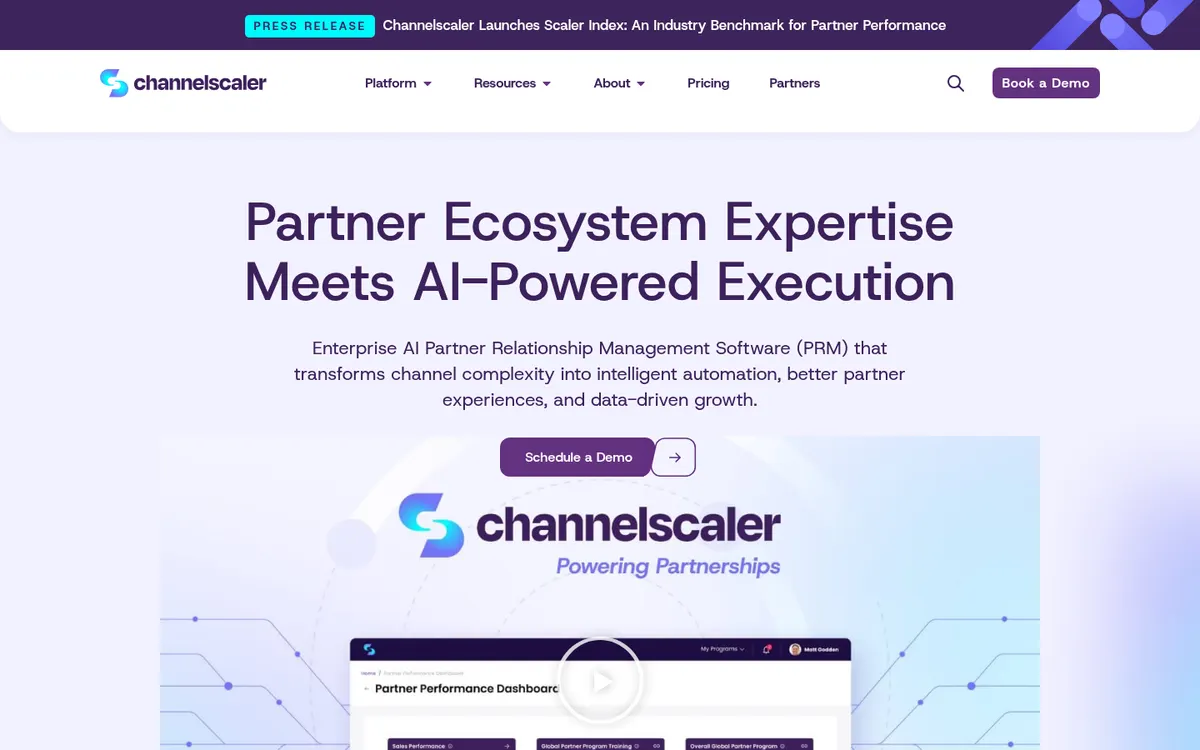
A modern portal with modular buying, held back mainly by unpublished pricing and a shorter enterprise track record.
Channelscaler is the rebranded Allbound product, and the lineage shows in the portal. Partner portal, deal registration, incentives and analytics are sold as modules rather than one bundle, so a team can start with deal registration and add incentives later without reopening the contract. The portal reads like modern SaaS rather than a partner extranet. Scaler Index benchmark data gives channel leaders a comparison point for program performance, helping justify a budget or tier change to a CFO. The product is designed by channel practitioners.
Pricing is not published. You still need a sales conversation to get numbers, covering modules and partner count. Budget for implementation help, because a modular platform still needs someone to decide which modules to switch on and in what order. The trade off is maturity: Channelscaler is a younger brand than Impartner or Salesforce, with fewer long-tenured enterprise references. Mid-market teams that want a usable portal without enterprise overhead are the sweet spot. Companies with complex multi-region compliance needs should ask harder reference questions before signing.
Pros
- Modular buying without forced bundles
- Portal usability above most rivals
- Benchmark data for program context
Cons
- No published pricing
- Fewer long-tenured enterprise references
- Implementation still needs internal owners
Pick it if
You want a modern partner portal and prefer buying modules as the program grows.
Skip it if
Procurement requires published rates or you need a long enterprise reference list.
Channeltivity
Modular editionsSee website (custom quote)No free planRubric 6.9
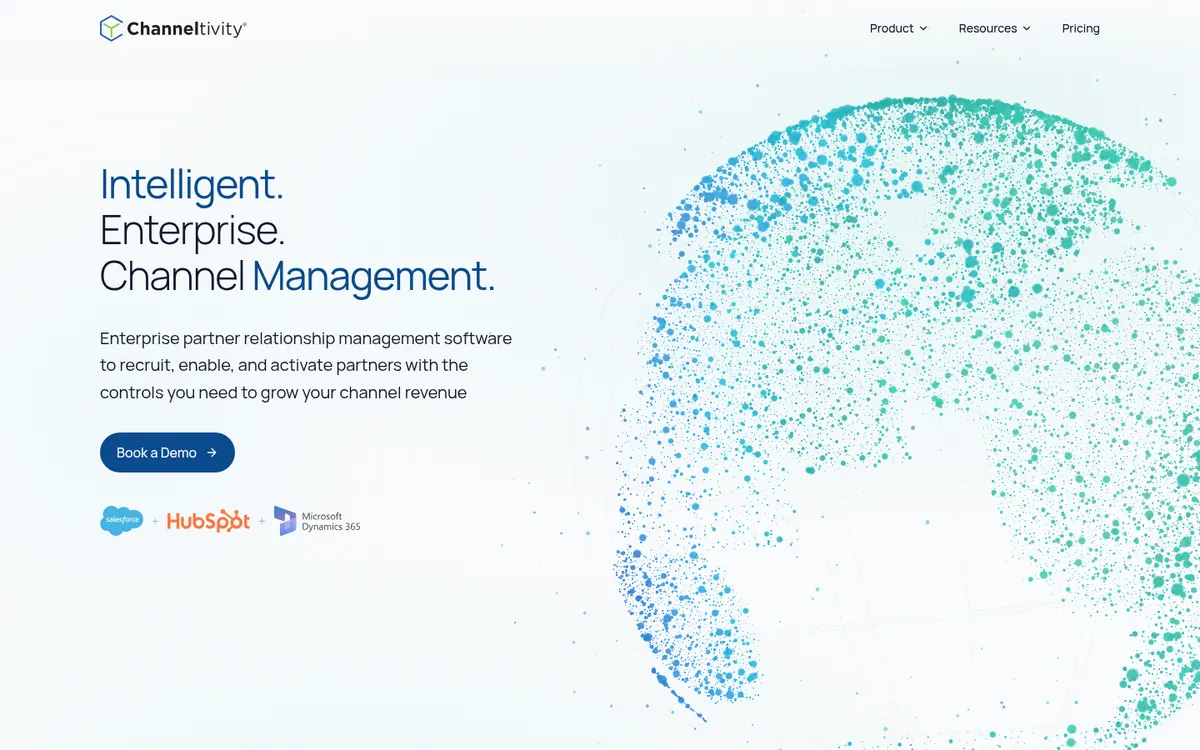
A dependable mid-market platform with clear editions and fast launch, undermined by unpublished pricing.
Channeltivity has sold into the channel market since 2003, the mid-market elder statesman. The platform combines partner recruitment and onboarding, deal registration with approval workflows, lead distribution, MDF management, a branded portal and reporting. Editions are tailored for HubSpot and Salesforce users, so the CRM question is answered before you start.
Modular editions are the appeal. A small program can buy a tier covering deal registration and the portal, then move up when it adds MDF or lead distribution. Launch is quick for a first program, which matters when partners are waiting and budget is tight. Deal registration with approval workflows in the same system as MDF stops two teams reconciling spreadsheets. Pricing is the weak spot: rates are not published, so pricing is by quote. Plan for an annual commitment and ask partner count per tier. Depth is the limit. Portal design and analytics trail the enterprise suites, and complex multi-region incentives will strain reporting. For a mid-market program that needs the basics done well and quickly, that trade is acceptable.
Pros
- Operating since 2003 with clear editions
- Fast launch for first partner programs
- Deal registration, MDF and leads in one place
Cons
- No vendor published pricing
- Pricing is only available by quote
- Portal and analytics trail enterprise suites
Pick it if
You want deal registration, MDF and a portal live quickly at mid-market scale.
Skip it if
You need deep portal design control or multi-region incentive complexity.
PartnerStack
Partner marketplaceSee website (custom quote)No free planRubric 7.0
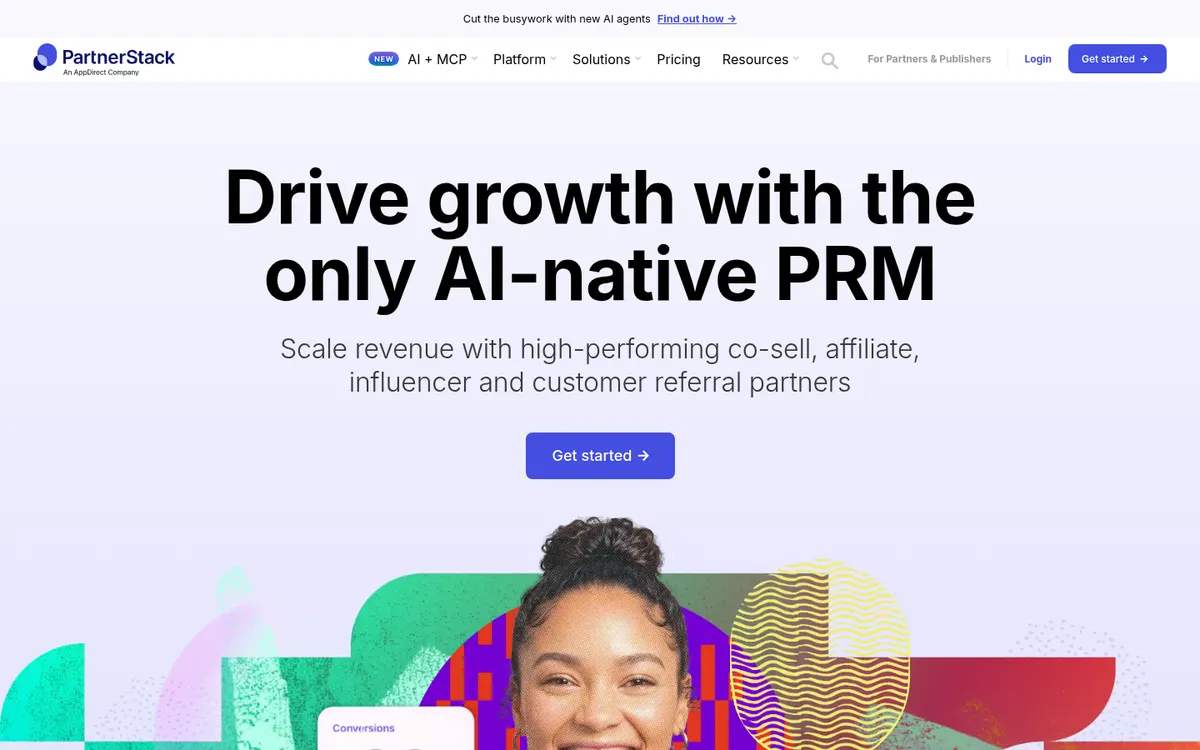
The pick for SaaS teams mixing affiliate, referral and co-sell partners, with a marketplace attached.
PartnerStack is built for B2B SaaS companies whose partner programs mix affiliate, referral, influencer and co-sell partners. Each type gets a separate onboarding path, because a blogger promoting a link and a reseller closing deals need different contracts, tracking and payouts. Automated commission payouts and full-funnel analytics sit across all of them, and AI-assisted lead submission speeds partner-submitted deals. The PartnerStack Network, a marketplace of partners looking for products to promote, most distinguishes the platform.
For a SaaS company with no partner list, the network can generate initial signups without a recruitment campaign. For niche or enterprise-only products, it adds less. Pricing runs through a demo. The free Spark tier covers simple referrals; Launch, Growth and Enterprise are custom quoted, skewing budgets toward funded SaaS companies. Customers typically launch in 30 to 45 days, slower than lean tools and faster than enterprise builds. If partners need enablement and marketing funds, pair it with something else or choose a broader suite. It fits SaaS companies with a partner-led growth motion, and fits poorly hardware distributors running tiered reseller programs.
Pros
- Multiple program types on one platform
- Built-in B2B partner marketplace
- Automated payouts across partner types
Cons
- Full platform is quote only
- Limited training and MDF depth
- Network value depends on your product type
Pick it if
You run affiliate, referral and co-sell partners and want payouts automated in one place.
Skip it if
Your partners need certification, MDF or deep reseller tier management.
Unifyr
Co-brandable campaignsSee website (custom quote)No free planRubric 6.9
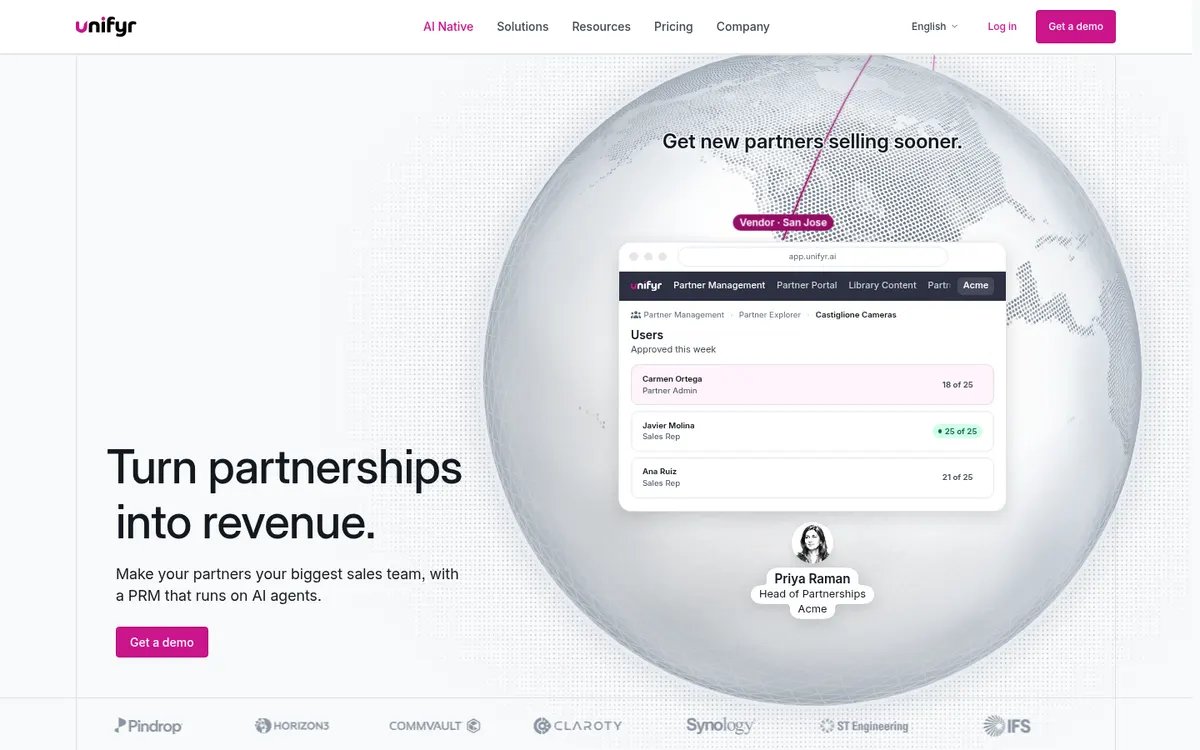
The strongest through-partner marketing engine here, best where partners fail at marketing rather than at deal registration.
Unifyr, formerly Zift Solutions and ZiftONE, is the marketing-first option. Through-partner marketing automation is the core: co-brandable campaigns, email and social syndication, microsites and content partners push under their own brand. A built-in LMS covers training and certification. Channel programs stall because partners do not market. Unifyr addresses that with campaign recommendations and agentic AI onboarding support that helps a new partner pick assets and launch a campaign without a marketer.
For distributor networks and hardware vendors, campaign execution can matter more than another deal registration form. Deal management and pipeline depth can feel secondary. If your program is pipeline-first, with co-sell account mapping and complex registration rules, a dedicated PRM will fit better. Pricing is not published: Activate, Grow and Scale show feature comparisons but no dollar figures, so expect a quote and scoping call. It fits channel teams that already handle deal registration elsewhere, or that see marketing enablement as the bottleneck. It fits poorly where partners chiefly need to register deals and get paid. Test campaign performance with a sector reference.
Pros
- Strong through-partner marketing automation
- Built-in LMS for certification
- AI support for onboarding and campaigns
Cons
- Pipeline and deal depth is secondary
- No published pricing
- Marketing-first framing narrows the fit
Pick it if
Your partners need co-branded campaigns and training more than another deal registration form.
Skip it if
Your program is pipeline-first with complex registration and incentive rules.
Kiflo
Published pricingCore $399/month (annual contract, up to 50 partners)No free planRubric 6.8
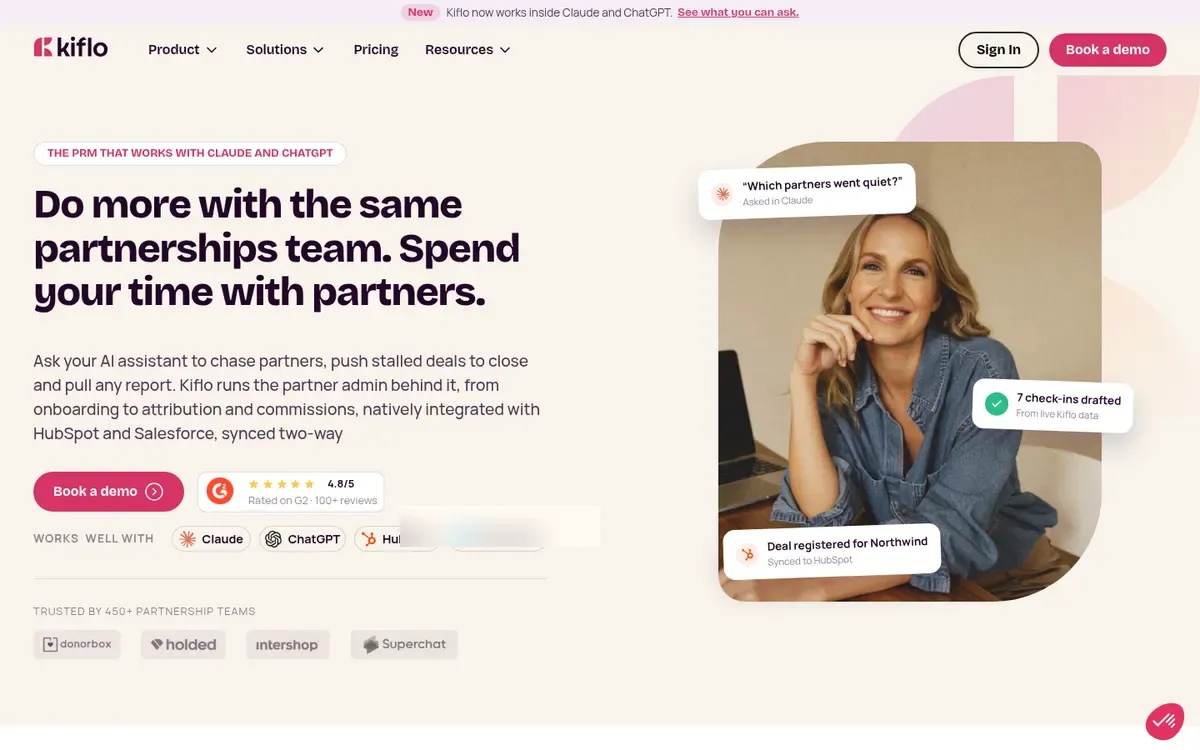
The clearest price and fastest start in this group, capped at 50 partners and three partner managers.
Kiflo is the easiest price here to plan against. Core lists at $399 per month on a 12-month contract, and the vendor FAQ puts the annual total at $4,788. The plan caps at 50 partners and three partner managers: a SaaS team launching a first partner program, with no appetite for an enterprise platform.
The feature set is narrower and covers essentials: partner portals, deal registration, automatic commission calculation, CRM sync, account mapping for co-selling, pipeline tracking and program management. Native HubSpot and Salesforce sync means the CRM stays the record of truth without middleware. Deployment is measured in days, and the annual-only contract means no month-to-month escape. Above Core, Plus and Premier are custom priced. There is no free plan; a free trial is available on request. It suits SMBs and SaaS teams that want a short rollout. It stops fitting past 50 partners, more than three partner managers, or multi-region incentives, compliance checks and fund claims. Buy it as a first platform, not the platform for larger scale.
Pros
- Published price with a stated annual total
- Fast deployment
- Native HubSpot and Salesforce sync
Cons
- Core caps at 50 partners and 3 partner managers
- 12-month contract only
- Custom pricing above Core
Pick it if
You are launching a first program with a small team and want a known monthly cost.
Skip it if
You already have more than 50 partners or need month to month flexibility.
Magentrix
Schema mirroringEssentials from $1,500/month (annual contract)No free planRubric 6.7
A portal that mirrors your CRM schema, powerful for technical teams and demanding for everyone else.
Magentrix sells a portal that mirrors your CRM schema instead of mapping fields. Point it at Salesforce, HubSpot or Dynamics and the portal reflects the same objects and relationships, so a custom object in the CRM shows up without an integration project. Customization goes further than most no-code tools: custom portal modules can be built through an IDE and a CLI.
The vendor says a portal can go live in as little as 1.5 hours, plausible for a first portal on an existing schema and less plausible with tiered rules and regional variations. Pricing starts at $1,500 per month for Essentials on an annual contract. Higher tiers are not listed. There is no free plan and no trial, only a demo. The catch is skills. Deep customization assumes developer resources, and no-code admins get less. It fits teams with a technical owner and a CRM to expose directly to partners, and fits poorly a channel team that wants to configure everything from a browser without tickets. Ask what Essentials includes before comparing broader suites.
Pros
- Mirrors CRM schema directly
- High customization with developer tools
- Portal reflects live CRM data
Cons
- Deep customization needs developers
- No trial or free plan
- Thin on channel marketing modules
Pick it if
You have a developer who wants to expose your CRM data to partners without field mapping.
Skip it if
Your channel team needs to configure the portal without engineering help.
ZINFI
Module breadthStarter $1,450/month ($17,400/year)No free planRubric 6.4
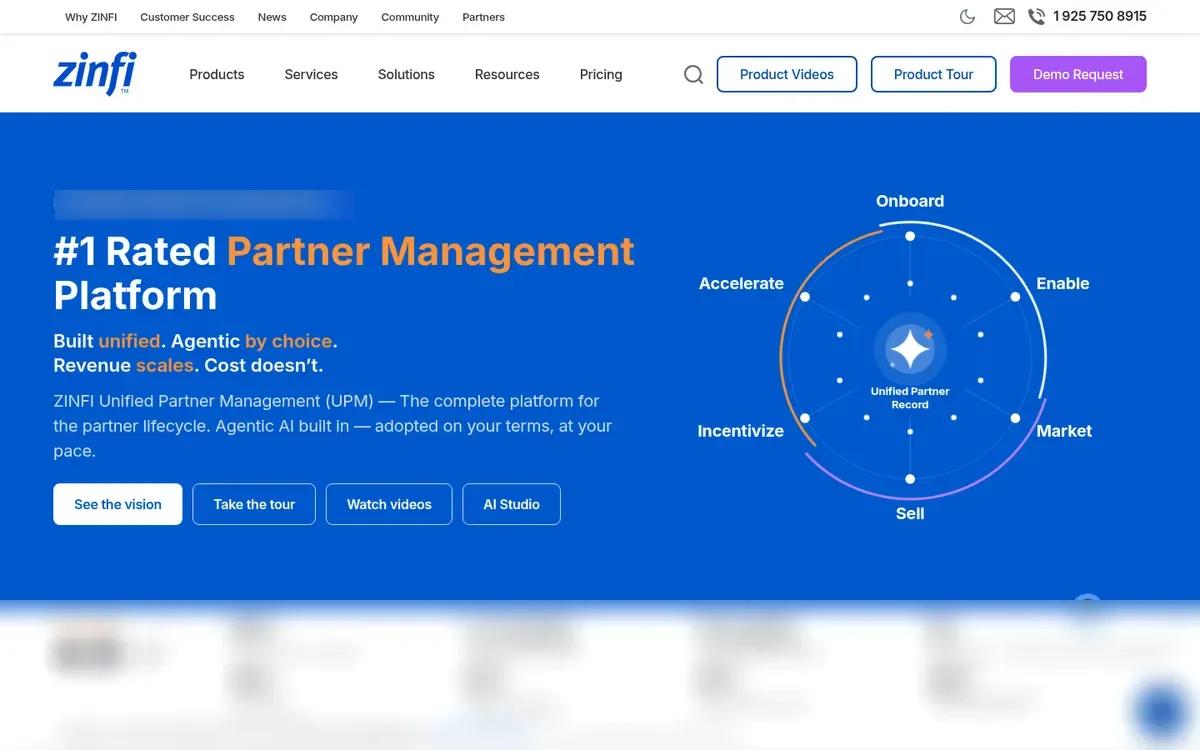
The broadest platform here, with a published starter price and a configuration burden that suits few small teams.
ZINFI sells breadth: 30 applications across six partner management zones, from onboarding and content libraries through deal registration, commissions, MDF, rebates, payments and a partner community. Sold modularly, it lets a buyer start with one zone and add others. Starter is listed at $1,450 per month, or $17,400 per year, an entry number without a sales call. AI features are optional switches with governance rather than forced automation, useful where an automated nudge to the wrong partner is a real problem.
The risk is shelfware. Breadth invites buying modules you never configure. The vendor advises a phased rollout: pick two zones, get partners using them, then expand. Portal usability is functional rather than modern, and the interface carries more configuration surface than a small team will use. It suits enterprises that want one platform across the lifecycle and will run a staged rollout. It suits poorly a small team that wants a portal live quickly, or a program that only needs deal registration. Compare the starter price with the modules you will use.
Pros
- 30 applications across six zones
- Published starter price
- Optional governed AI switches
Cons
- Breadth invites unused modules
- Configuration heavy for small teams
- Portal feels dated next to newer tools
Pick it if
You want one platform for the full lifecycle and will roll it out zone by zone.
Skip it if
You need two or three modules and a portal partners can use without a walkthrough.
What does partner relationship management software actually do for a channel program?
Partner relationship management software is the system a vendor uses to recruit, onboard, enable, track and pay the companies that resell, refer or co-sell its product. It sits between your CRM and your partners, and it usually owns four jobs at once: a portal where partners log in, a deal registration workflow that protects their pipeline, an enablement layer for training and marketing content, and a reporting layer that tells you which partners produce revenue. The category overlaps with affiliate software but is not the same thing. Affiliate tools track links, clicks and commissions for high-volume, low-touch programs. PRM assumes named partner accounts, a sales cycle, and often a human relationship manager. That is why PRM platforms carry deal registration, account mapping and co-sell pipeline views, while affiliate platforms carry tracking links and self-serve signup. Core modules in the platforms reviewed here: - Partner recruitment and onboarding
- Deal registration and lead distribution
- Training, certification and content syndication
- Market development funds, rebates and commission payouts
- Pipeline and program analytics Who buys it: B2B software companies with indirect revenue, hardware and manufacturing firms with reseller networks, and services businesses with referral partners. The size of the partner list drives the decision more than company size does. A small partner program can run on a lean tool with a free tier, while a large global network usually needs compliance checks, multi-currency incentives and a dedicated administrator. What it costs in time: the lightest implementations in this guide claim launches in days, while enterprise builds take longer. That gap matters more than the sticker price, because internal hours usually exceed the subscription in year one. Do you need it at all? If partners only need a referral link, no. If partners need to register deals, access training, claim marketing funds and see their own pipeline, a CRM alone gets expensive to maintain and a spreadsheet stops scaling as the program grows.
This comparison sits on the Sales desk. Readers comparing neighbouring stacks often check our guides to email marketing platforms for ecommerce and brand protection software next.
How PRM software pricing works in 2026
PRM contracts often bill annually, and the number is driven by partner count, modules and implementation hours rather than by seats alone. Several pricing shapes show up in this list. | Model | How it bills | Typical fit | Example from this list | | --- | --- | --- | --- | | Published tiers | Monthly or annual list price with partner and manager caps | SMB and mid-market first programs | Kiflo Core at $399/month on a 12-month contract, $4,788 per year | | Published starter plus modules | Annual list price, extra zones priced separately | Enterprises starting with one zone | ZINFI Starter at $1,450/month ($17,400/year) | | Quote only enterprise | Annual contract priced on partners, modules and regions | Large global channel networks | Impartner, see website | | Platform licensing | Annual licensing on an existing CRM, plus build cost | Salesforce shops with admin capacity | Salesforce PRM on Experience Cloud | | Free entry plus quote | Free tier, paid tiers quoted by partner count | B2B SaaS teams testing a program | Introw Starter (one partner), PartnerStack Spark | Three things move the price more than the headline rate. Partner count is the first: published plans often cap it and quoted plans often scale with it, so a low entry tier can become more costly as the program grows. Modules are the second: ZINFI, Channelscaler and Channeltivity all sell components separately, which keeps the first contract small and makes expansion predictable. Implementation is the third and can be a large cost in year one, since CRM integration, data migration and portal content all consume internal or consulting hours. Trials vary in this category. Many vendors offer a demo, and some offer a free plan or a paid proof of concept instead. Magentrix lists Essentials from $1,500 per month with no trial, while Introw and PartnerStack use free tiers as the entry point. Budget for an annual commitment unless a vendor states otherwise.
Every price above was checked on the vendor's own pricing page on November 25, 2026. Where a vendor does not publish a figure we write "See website" instead of guessing. To compare annual and monthly billing quickly, try the free percentage calculator.
Which PRM software fits your program? A six step decision path
- Count partners and program types. A small partner program with one program type points toward Kiflo or Introw. A large global program across regions and incentive tiers points toward Impartner, Salesforce PRM or ZINFI. Write the number down before any demo, because it changes every quote you get. 2. Name your source of truth. Decide whether Salesforce, HubSpot, Dynamics or a standalone database owns partner records. Native operation removes a sync layer and a class of support tickets, while a separate system gives you more built-in channel features on day one. 3. List the modules you will switch on in the near term. Deal registration and a portal are table stakes. Training, MDF, rebates and partner locators are the ones that decide whether you need an enterprise suite or a lean tool. Score only the modules you will configure before the next quarter ends. 4. Get a quote with your real partner count. Ask each vendor for a price at your current partner count and at double it. That second number is the one that matters, because pricing that scales with partners turns a comfortable subscription into a budget conversation at exactly the moment the program starts working. 5. Ask for the implementation plan and the hours. Request a written scope with named tasks, internal hours and the vendor's responsibilities. Compare that against the launch claims in this guide, then ask which reference customer had a comparable CRM setup and how long their build actually took. 6. Pilot with a small group of partners before you sign wide. Run that group through registration, login and one full deal cycle. Partners who cannot complete a registration on a phone without help are telling you something about the portal that no demo will show you.
PRM buying mistakes that stall a rollout
- Buying breadth before basics. A 30-application platform looks safer on a scorecard, but unused modules still need configuring and reviewing. Teams that start with deal registration and a portal usually launch faster and add zones once partners log in without prompting. - Treating the portal as an IT project. Channel teams that hand the build to IT and return six months later get a technically correct portal nobody uses. Partner managers need to own the content, the tier rules and the registration approvals from week one. - Skipping the partner experience test. Demos run on clean data with a presenter driving. Watch three real partners try to register a deal on a phone, and you will learn more about usability than from any feature comparison table. - Ignoring contract length and partner caps. An annual-only contract with a partner cap is fine for a first program and painful as the program grows. Ask what happens at the cap, what an upgrade costs, and whether the price resets at renewal. - Assuming the CRM sync will just work. Field mapping, duplicate records and custom objects break syncs quietly. Ask which CRM objects the platform writes to, who owns conflict resolution, and what the vendor's support scope covers when a record lands in the wrong place.
Frequently asked questions
What does PRM software do for a partner program?
It gives partners one place to register deals, reach training and marketing content, and see their pipeline, while giving you the reporting and controls to run the program. It replaces spreadsheets, email threads and shared drives, and it usually connects to your CRM so partner revenue lands in the same forecast as direct revenue.
How is PRM software priced in 2026?
Pricing is often on annual contracts priced by partner count and modules. Some vendors publish list prices, such as Kiflo Core at $399 per month, ZINFI Starter at $1,450 per month and Magentrix Essentials from $1,500 per month. The largest suites quote privately; see the vendor website for pricing.
What is the difference between PRM and affiliate software?
Affiliate software tracks links and pays commissions on high-volume, low-touch referrals. PRM manages named partner accounts through recruitment, onboarding, enablement and co-sell pipeline. PartnerStack sits in between because it runs affiliate, referral and co-sell programs on one platform, while the enterprise suites here assume named partners and a sales cycle.
When is Salesforce PRM worth the investment?
When Salesforce is already your system of record and you have admin capacity to build and maintain the portal. Partner data then lives natively in the CRM with no sync layer, and security controls inherit from the platform. Without existing Salesforce skills, a purpose-built platform usually costs less in year one and launches much faster.
How long does PRM implementation take?
It ranges from days to longer enterprise builds. Introw says most teams launch in 2 to 4 days, Magentrix says a portal can go live in 1.5 hours when content is ready, and PartnerStack customers typically launch in 30 to 45 days. Enterprise builds with data migration and custom modules run longer and need dedicated staff.
Can a small business use PRM software?
Yes. Introw's Starter plan is free for one partner, PartnerStack has a free Spark tier for simple referrals, and Kiflo Core lists at $399 per month for up to 50 partners. Admin time can matter as much as license cost.
Still choosing a tool?
Browse every comparison on the Sales desk, with the same rubric and dated prices.